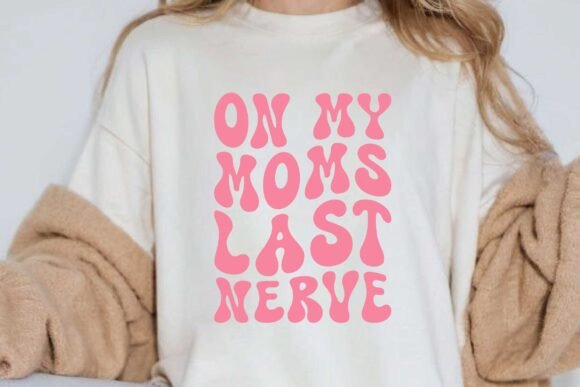
On My Mom’s Last Nerve SVG
Let’s be honest—this isn’t just another snarky phrase on a T-shirt. As a designer who’s stitched, tested, and sold hundreds of embroidery files for small businesses and crafters, I opened On My Moms Last Nerve SVG expecting cheeky charm—and found something more: a design with real personality, commercial instinct, and quiet versatility.
I recently used it to embroider a set of cotton canvas tote bags for a local mom-owned boutique. The shop specializes in lighthearted, relatable gifts—think baby showers, teacher appreciation, and “surviving parenthood” merch. When the first bag came off the hoop, the reaction wasn’t just laughter—it was recognition. That’s the sign of a well-calibrated embroidery file: it lands emotionally *and* technically.
First Impression: Sassy, Clean, and Stitch-Ready
The layout is compact but generous—no cramped letters or awkward kerning. The phrase flows in a gentle arc, not rigid block text, which gives it natural rhythm under needle. There’s no extra ornamentation (no hearts, stars, or cartoon moms), so it avoids aging quickly or limiting audience appeal. It reads as confident, not cutesy—a subtle but critical distinction for handmade product buyers who value authenticity over cliché.
As an embroidery file, its strength lies in restraint. The letterforms are bold enough for satin stitch definition but open enough to avoid dense fill areas that bog down stitching time or bleed on lightweight fabric. No fine serifs or delicate connectors—just clean lines built for real-world execution.
Where It Shines (and Where It Needs Care)
On My Moms Last Nerve SVG works beautifully on mid-weight cottons and blends—think sweatshirts, tea towels, aprons, and pillow covers. On a brushed cotton sweatshirt? Crisp. On a linen kitchen towel? Legible and grounded. As a patch? Easily digitized for clean edge binding.
It’s also a smart pick for baby embroidery—if you’re stitching it onto a onesie or burp cloth, keep the size at 3–4 inches wide and use a lightweight cutaway stabilizer. The font weight holds up well even at smaller scales, unlike many script-based phrases that vanish when shrunk.
That said, proceed thoughtfully with stretchy fabrics like jersey knits or curved surfaces like caps. The arc works best on flat or gently contoured areas—on a baseball cap front, consider flattening the curve slightly in your embroidery software before digitizing. And while the design avoids tiny details, always test the file on scrap fabric first: check how thread colors interact with your base (especially on dark fabric), confirm stitch density doesn’t overwhelm thin weaves, and verify that corners and ends anchor cleanly without puckering.
Commercial Use: Why Craft Businesses Keep Coming Back
Etsy sellers and small shop owners love this file because it bridges humor and heart—without tipping into irony fatigue. It’s not trying too hard. That makes it easy to integrate into cohesive collections: pair it with “Mom Fuel,” “Nap Time Is Sacred,” or “I Make Mistakes & Coffee” for a themed line. As digital embroidery assets go, it’s low-risk and high-return—minimal editing needed, strong visual recall, and broad demographic reach (moms, teachers, therapists, aunties, grandmas).
For commercial embroidery projects, its clean vector foundation means smooth scaling across formats: from 2-inch patches to 6-inch tote bag centerpieces. Because it’s offered in SVG, EPS, DXF, PDF, PNG (300 dpi, transparent), and JPG, it adapts easily to both machine embroidery prep and printable mockups—essential for social media listings or client approvals.
Design Integrity Meets Handmade Presentation
What separates a good embroidery file from a great one isn’t just resolution—it’s how it supports the *feeling* of the finished product. On My Moms Last Nerve SVG enhances perceived value because it looks intentionally designed, not slapped together. That matters when customers scroll past dozens of similar listings. A well-executed satin stitch around each letter, balanced spacing, and consistent stroke weight all signal professionalism—even on a $25 tote.
It also builds trust. Buyers don’t want to wonder if their custom order will look muddy or misaligned. This file delivers clarity out of the gate, especially when paired with proper stabilizer and thread color contrast. I tested it in navy thread on oat-colored linen—sharp, warm, and unmistakably handmade.
Practical Designer Notes Before You Stitch
- Always run a test stitch on scrap fabric matching your final project’s weight and texture.
- Check thread color contrast—especially for light-on-light or dark-on-dark applications.
- Review stitch density in your embroidery software; reduce if working with delicate or loosely woven fabrics.
- Confirm hoop size compatibility before loading—some versions may require a 4×4 or larger.
- Inspect small details like terminal points and inner counters (e.g., the “o” and “e”) to ensure they won’t collapse during stitching.
- Test black-and-white mockups to evaluate readability at distance and on varied backgrounds.
- Verify licensing terms before selling finished embroidered items or reselling the digital embroidery file—this is essential for Etsy sellers and craft business owners.
A Final Thought for Makers
This isn’t just a graphics download—it’s a conversation starter, a gift with attitude, and a reliable workhorse for your craft business inventory. Whether you’re embroidering a holiday gift for your sister-in-law or building a best-selling Etsy collection, On My Moms Last Nerve SVG earns its place because it balances wit with wearability, simplicity with impact, and fun with finish-quality craftsmanship. In the world of Crafts and Graphics, that’s rare—and worth keeping on repeat.